30 Years of Sportrock Alexandria and an Infinite Commitment to the Climbing Community

by Michael Nanney, CEO
I still remember standing there 30 years ago, a relatively new member of the climbing community, just two weeks shy of my 20th birthday, waiting for Sportrock Alexandria to open its doors for the first time. Technically, I was second in line behind my soon-to-be friend Dan. Unfortunately for him, he was 17 years old and had to go home to have one of his parents sign his participation waiver. And, just like that, I accidentally became Sportrock Alexandria’s first member.
It was an event that would ultimately change the trajectory of my entire life.

I started rock climbing in the summer of 1995 at Carderock, Maryland, and Great Falls, Virginia, after some older (i.e., 20 years old to my 19) and more “experienced” climbers (having gone half a dozen times before) took me and some friends climbing outside.
We shared climbing shoes and harnesses (and, consequently, a good bit of each others’ sweat) and had a great time. From that point forward, I said yes to every invitation from those guys, for as long as the weather complied, eventually picking up some used gear and additional climbing partners.

I loved the challenge, and I’ve always been happiest outdoors. But, more than that, the climbing community in the 90s was a counterculture. The obscurity of the sport, coupled with the inherent danger of dangling in the air from a thin strand of rope, made me feel cool. And, in the end, everyone wants to be cool. It was a promising start to my life as a climber.
There was just one problem: I wasn’t nearly as talented at rock climbing as I wanted to be. And, over the course of my first dozen climbing sessions, I only seemed to get worse. Something had to give.
A Place to Climb, Train, and Learn to Suck Less
This is how I found myself standing outside Sportrock Alexandria, waiting for the doors to open.
My friend Brendan had been climbing at Sportrock’s (now closed) Rockville location, which opened two years earlier, in 1994. Even back then—when the climbing community was considerably smaller—it wasn’t the first indoor climbing facility in the area; that honor belonged to Clipper City in Baltimore and, before that, the garage of Steve Zich’s parents in Chevy Chase, DC, where the first iteration of Sportrock was born.
To improve my technique and stamina, Brendan recommended that I start climbing indoors. Well, what he actually said was something along the lines of, “It would be nice if you didn’t suck quite so bad when we climb outside together next time.”
Sportrock Alexandria back then looked very different than it does today. All of the original bouldering is long gone, today’s retail shop previously housed the facility’s only two small restrooms, and most of today’s gym terrain was yet to come. And Bay 2? That wasn’t even a pipe dream, let alone Bay 3 with its 60-foot walls and multi-pitch ledge.

And yet, despite its small size, Sportrock felt huge to me, and the walls inspired me so much. As a Carderock climber, I had never seen anything like that lead arch. The idea that one day I might be able to climb it both terrified and excited me. But above all, it motivated me.
Looking back, what really stood out to me that first day was the community that already existed. The front desk staff all knew each other. A bunch of routesetters were up on the ropes, joking around together. And meanwhile, as I filled out my (then-paper) participant waiver, a procession of regulars from Sportrock Rockville were checking in to see the new gym, shaking hands, hugging, catching up, and belaying or spotting each other. Although I was brand new to Sportrock, lots of people clearly already felt at home there.
In those first weeks, as I watched people warm up on climbs I could only dream of sending, what I most remember is how inspired I felt. I recall very clearly deciding that 5.12 was “the realm of the Gods” and concluding that, even in my wildest dreams, I wouldn’t come close to that. And it wasn’t just their climbing ability that struck me: Many of the people I met had been part of the climbing community for years. They knew how to lead, had graduated from college, had girlfriends, owned Jeeps, and had less credit card debt than me—all clear markers of extraordinary success to my 19-year-old eyes. To me, they were living, breathing proof that, counter culture or not, climbing was a way of life worth living.
By the end of that first month I was hooked—and also grappling with a harsh reality: I couldn’t actually afford the $40 monthly membership fee that I had already agreed to pay. Employees, however, automatically received free membership, and I could definitely afford that.
So I applied, got the job, and now, 30 years later, here I am, still working for Sportrock.
A History of Renovation, Innovation, Perspiration

Of course, the Sportrock of 30 years ago was much different from today. Back then, my fellow employees and I did literally everything. We checked people in at the front desk, set routes, belayed for birthday parties, cleaned toilets, sold Clif Bars, and vacuumed the padded floors (which, back then, were constructed of burlap and leftovers from the rubber used to make the soles for Teva sandals).
But climbing was growing in popularity, and it wasn’t long before the Alexandria gym needed its first round of renovations. From that point forward, Sportrock has been in a constant state of motion, committed to meeting the increased demand by providing an entire region with accessible, world-class climbing facilities. The list of improvements we’ve made over the past 30 years is dizzying:
In the summer of 1998, Alexandria underwent its first renovation, with the addition of the back buttress, slab wall, 40-foot hand crack, and a 45 degree bouldering wall located at what today is the entrance to Bay 2. The next year my soon-to-be close friends and New River Gorge climbing partners Brian Quinlan and Lillian Chao-Quinlan joined Sportrock and took a class with my college roommate, Dave. (At the risk of dating myself, Dave introduced us to one another at a Blockbuster Video store. If you know, you know. If you don’t, don’t worry about it.)
In 2001, Sportrock opened its Sterling location. (That’s right: In addition to being Alexandria’s 30th anniversary, this year also marks Sterling’s 25th birthday.) Almost a third larger than Alexandria was at the time and with bouldering walls two feet taller, Sterling was the nicest climbing gym any of us had ever seen at that point. Back then, Sportrock’s Alexandria employees referred to Sterling as “our winter crag.” We went there every weekend the weather did not cooperate at the New River Gorge—where, that very same year, I watched Lillian (by then a very dear friend) climb her first 5.13, Quinsana Plus. It was an incredible feat for someone who only started climbing two years earlier. Sending that route ultimately set the wheels in motion for Lillian to eventually take over Sportrock as President and for me to become a Sportrock shareholder.
In 2009, Alexandria saw its next renovation, as we expanded into Bay 2. That space was defined by the dedicated kids’ “canyon,” the former (and always beloved) bouldering prow, and the gym’s first foray into an expanded general fitness area.
Next, in 2015, Sterling got its own first renovation. The Rockwerx arch was constructed, and the gym expanded into what we called “the suite,” allowing us to add a dedicated kids party area, a yoga room, and a general fitness space.
The year 2017 saw some of Alexandria’s most extraordinary growth. Our expansion into Bay 3 brought with it world-class climbing on the tallest indoor walls in the region.
In 2020, Alexandria expanded again, with the opening of the Sportrock Performance Institute, a dedicated space for highly driven and competitive members of the climbing community to hone their skills, grow their strength, and crush some of the most challenging indoor bouldering routes in the region.
In 2023 Sportrock returned to its Montgomery County, Maryland roots when we opened Sportrock Rio, our first new gym in 22 years. It’s also our largest, almost the size of Alexandria and Sterling combined.
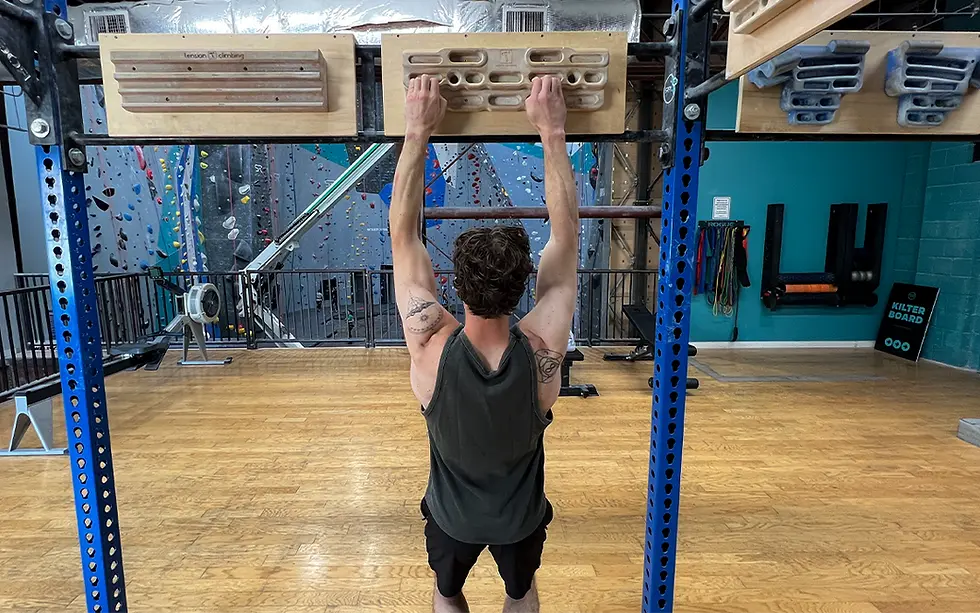
The following year brought another round of renovations to Alexandria. This time, we doubled the cardio space and turned the Bay 3 mezzanine into a true training space, complete with a pull-up station, Kilter board, Moon board, and a spray wall. Meanwhile, in Bay 2, we updated the bathrooms, and, most notably, remodeled our bouldering terrain.
By January 2025, it was Sportrock Sterling’s turn for another transformation. This time, we improved the weightlifting, cardio, and yoga spaces. Best of all, we were able to double the gym’s bouldering square footage and deliver what, in my humble opinion, is Sportrock’s sickest bouldering terrain to date.
Last but not least, this summer we opened our fourth indoor rock gym, a new bouldering facility in the historic Lorton Reformatory dining hall. For those who loved that old Bay 2 prow as much as I did, just wait until you see this new terrain.
A Commitment to Inspiring the Sportrock Climbing Community
By now, you might be noticing a theme in Sportrock’s renovations: With each one, we’ve bolstered our commitment to creating dedicated and diverse spaces for every type of climber and member—from large families to broke college students to aspiring USA Climbing national team members.
Over the last decade, private equity has bought out a shocking number of climbing gyms around the U.S. But Sportrock? We pride ourselves on being For Climbers, By Climbers. That’s why we’ve stayed local and family-owned.

In fact, for more than 20 years none of the company’s shareholders (including Lillian and myself) have ever taken a distribution of Sportrock’s profits. Instead, whenever Sportrock has been fortunate enough to make a profit, we’ve put those dollars back into this company that has changed our lives. That’s what has paid for these renovations. Why? Because while running a sustainable business is paramount, profit is not our primary objective and hasn’t been for more than two decades.
From the start, Sportrock has been determined to broaden the fitness and training opportunities we can provide our community, and, by extension, to inspire them to keep growing as climbers and athletes. We’ve taken it slow, and only spent what we made (every dollar of it, plus a few bucks we didn’t have.) In the process, I’ve watched Sportrock evolve from a struggling small company to the thriving business it is today, with close to 400 employees, thousands of members, weddings hosted, presidential visits, pandemic closures, and, most importantly, countless lives changed—mine included.
Though my Sportrock story started as Alexandria member no. 1, every climber who has come through our doors has their own Sportrock story. Whether you started climbing at the gym yesterday or you have been a member since the Sportrock Rockville days, we all share this common ground. It is a powerful feeling to know that wherever my life takes me I will always be able to find my way back to this community, this pursuit, and this feeling of commonality that Sportrock has provided me all these years. I could not be more grateful for that.